openspace
Live demo: https://space.lastra.us
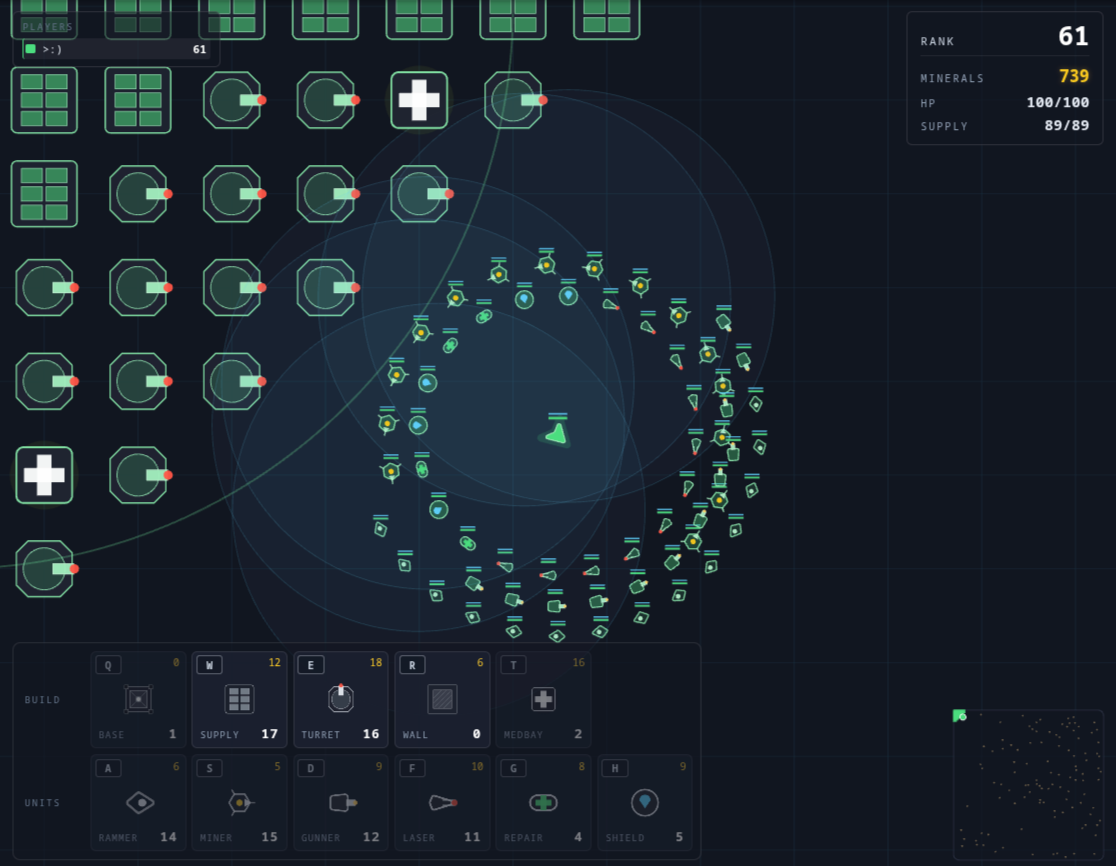
Multiplayer top-down arena. Drop a base, mine asteroids, wall yourself in, build turrets, command a fleet of AI escort drones, and brawl other players. Server-authoritative physics via Rapier2D, geometric Pixi.js rendering, Colyseus state sync, Svelte 5 HUD.
Quick start
pnpm install
pnpm dev
Open http://localhost:5173 in two browser tabs, pick a name, fly with the cursor.
Controls
| Key | Action |
|---|---|
| Mouse | Steer toward cursor |
| Left-click | Designate focus target — owned attack units pursue and fire on the picked enemy / miners pursue the picked asteroid. Click empty space to clear. |
| Space (hold) | Recall fleet + sustained dash — burns your own units while held |
| A / S / D / F / G / H | Spawn rammer / miner / gunner / laser / repair / shielder |
| Q / W / E / R / T | Toggle base / supply / turret / wall / medbay placement (click to place) |
| X | Recycle mode — click an owned structure for partial credit refund |
| Esc or Right-click tap | Cancel placement / recycle mode |
| Right-click hold + drag | Open radial emote menu, drag to a wedge to send |
| F1 | Debug overlay (hitboxes, target lines, prediction divergence) |
You start with a free base (Q) and a small credit pile. Drop the base to unlock unit production — units spawn at your base and respawn there on death. Mine asteroids with miners (per-tick drip while attached), spend credits on units and structures, and your base projects a 600u territorial claim that blocks enemies from building near you. Walls are one-way: your own units, ship, and projectiles pass through your walls; enemies are stopped. The world center has a no-build spawn bubble and fresh ships get 20s of spawn invulnerability. Lose your ship and you drop a gold wreckage square holding your credits + orphaned units — first player to touch it claims everything (expires after 30s).
Commands
| Command | Effect |
|---|---|
pnpm dev |
Server (2567) + client (5173) with hot reload |
pnpm typecheck |
Strict TS across all packages (incl. svelte-check) |
pnpm lint |
ESLint over the repo |
pnpm test |
Vitest for shared pure helpers |
pnpm build |
Production builds (shared → server → client) |
Architecture
packages/shared/      cross-process source of truth
  schema.ts           Colyseus Schema (ArenaState, Player, Unit, Structure, Wreckage, Projectile, Asteroid)
  constants.ts        world dims, tick rate, gameplay tunables
  kinds.ts            UNIT_KIND_META — rammer / miner / gunner / laser / repair / shielder
  structures.ts       STRUCTURE_KIND_META — base / supply / turret / wall / medbay + recycle math
  combat.ts           Combatant union; type guards; targeting helpers
  formation.ts        multi-ring orbit slot math (server + client agree)
  movement.ts         stepPlayer (used by client prediction; server uses Rapier)
  types.ts            wire message types (inputs, build/recycle, GameEvent, EmoteMessage)

packages/server/
  rooms/ArenaRoom.ts  Colyseus room; message handlers; SimContext; per-player owner-bit allocator
  physics.ts          Rapier wrapper (bodies, colliders, contact draining, owner-bit collision groups)
  simulation.ts       per-tick orchestrator: input → AI → step → collisions →
                      mining → abilities → repairs → shields → projectiles →
                      dash burn → explosions → wreckage claim → cull/respawn,
                      with a transient event channel (kills, base-attack alerts)
  behaviors.ts        per-kind targeting + desired-velocity registry
  spatial.ts          uniform-grid neighbor index for O(1) acquire / aura queries

packages/client/
  main.ts             bootstrap: renderer, net, HUD, join overlay
  game.ts             frame loop, input, placement, FX wiring, event handler
  net/client.ts       Colyseus wrapper exposing typed snapshots + emote send + onEvent
  prediction.ts       client-side prediction for the local ship
  interpolation.ts    snapshot interpolation for remote entities
  entities/           LocalPlayer, RemotePlayer, Unit, Structure, Asteroid, Projectile, Wreckage
  render/             Pixi views (ships, units, structures, minimap, background,
                      wreckages, mining particles, heal tethers, build icons)
  effects/            death burst, respawn pulse, explosions, beams, bullet pops, emote bubbles
  hud/                Svelte 5 components — Hud (root), StatsPanel, PlayerList, BuildHud,
                      JoinOverlay, RespawnOverlay, EventFeed (top-center toasts),
                      RadialEmoteMenu (right-drag wheel), DebugPanel, Status
debug/overlay.ts F1 toggleableAuthority + physics
- Server runs Rapier. Players, units, structures, asteroids are all rigid bodies. Most use ball colliders; walls use cuboid colliders so adjacent placements form a continuous barrier with no diagonal gaps. Each tick: write desired velocities, step, drain contact events for damage, read positions back into the schema.
- Owner-bit collision groups. Each player gets one of 15 bits at join (freed at leave). Walls filter that bit out of their collision mask, so the wall's owner — units, ship, projectiles — pass through freely while enemies still bounce off. This sidesteps pathfinding entirely: units inside a wall ring flow out to engage; respawn at base isn't trapped by your own walls. Bit transfer is wired into wreckage claim too — claimed units re-collide against their new owner's walls.
- Client predicts the local ship kinematically (no Rapier in the
browser bundle) using
stepPlayerfrom shared. Reconcile snaps to authority when drift exceeds threshold. The predictor's obstacle list excludes the local player's own walls so prediction agrees with the server's owner-bit filter. - Remote ships and units interpolate server snapshots ~150ms behind server time. Bullets extrapolate from the latest snapshot anchor so hits land where the server saw them, with no interpolation lag.
- Density-based mass: ship density 12 vs unit density 1 — heavy ships glide through unit clusters without jitter.
- Area-of-interest filtering via Colyseus StateView: each client only sees entities within ~1500u of its ship (with hysteresis to kill edge-flicker).
Combat + economy
- Every Combatant has hp/maxHp and (optionally) shield/maxShield. Damage drains shield first.
- Collision damage scales with relative velocity (engine-wash from a dashing ship melts your own fleet too).
- Units acquire nearest enemy in
aggroRadius(sticky toreleaseRadius, with neutral-target rejection so dead-player wreckage units don't keep half the map locked on them). Behaviors: ram, kite-and-shoot (hitscan laser, ballistic gunner), repair beam, shield aura, mine. - Manual focus targeting layered on top: left-click an enemy or
asteroid to set
Player.focusTargetId. Owned attack units (rammer, gunner, laser) pursue that target across the map regardless of aggro/release radii; miners pursue a focused asteroid the same way. A pulsing crosshair tinted to the player's color marks the chosen target. Server clears focus on death and per-tick when the target no longer resolves. - Per-player supply cap from depots. Excess units flip to a deactivated state and inertly orbit until cap returns.
- Base (Q, free, max 1) gates all unit production and projects a 600u territorial claim that blocks enemy structure placement. Walls (R) are tough one-way barriers, turrets (E) are 96-DPS hitscan defenders, medbays (T) heal everything friendly in a 320u aura including walls, supply depots (W) raise your unit cap. All structures snap to the 100u grid and can be recycled (X) for up to 75% of their cost, scaled linearly by remaining HP.
- Spawn safety: a no-build bubble around world-center prevents walling in the spawn zone, and fresh / respawned ships get 20 seconds of damage immunity (visualized as a pulsing alpha on the ship).
- Wreckage: dying drops a gold square sized by your credit pile, holding your credits and orphaned units. Touch to claim. Expires after 30s. Click-to-respawn — death leaves you gone until you press the button.
Events, emotes, alerts
A transient event channel rides alongside the schema (Colyseus messages, not synced state) for one-shot signals:
- Kill toasts stack top-center for everyone in earshot — name vs name, dimmed for environmental kills.
- Emotes — right-click hold opens a 9-wedge radial menu (greet,
help, attack, truce, thanks, love, laugh, cry, rip). Drag-release
fires; tap-without-drag cancels. Server rate-limits to 1/sec/player,
enum-validates, and broadcasts an
EmoteEventthat renders both as a top-center toast AND a world-space bubble that pops above the sender's ship and floats up over ~2s. - Base-under-attack alerts fire privately to the base owner only, cooldowned at 30s/base so a sustained attack only pings once.
Adding a unit kind
The simulation tick, network layer, and HUD don't change.
packages/shared/src/kinds.ts— register stats inUNIT_KIND_META.packages/server/src/behaviors.ts— register a behavior inkindBehaviors.packages/client/src/render/units.ts— add acaseincreateUnitView.- Bind a key in
game.ts(net.spawnUnit("yourkind")).
pnpm test && pnpm typecheck && pnpm lint should stay green.
Adding a structure kind
Mirrors the unit pattern. Check STRUCTURE_KIND_META (base, supply,
turret, wall, medbay) for the available fields — colliderShape,
maxPerPlayer, healHps/healRange, abilityRange/abilityDamage/
abilityCooldownSeconds are all optional toggles, so most structures
are a few lines of config plus a render case in
packages/client/src/render/structures.ts. Wire a placement key in
game.ts (the existing pattern is one input.onKeyTap per kind that
flips the placing mode).
Known landmines
- Schema decorator emit: TS class-field initializers shadow
defineTypesgetters. Use constructor-init pattern withuseDefineForClassFields: false. - DPR drift: camera math uses
app.canvas.getBoundingClientRect(), notrenderer.width / resolution(Firefox disagrees). - Server time monotonic:
state.serverTime = performance.now(). - Rapier init is async — cached at process scope, shared across rooms.
- Body cleanup is mandatory:
removeRigidBodyon every destroy,world.free()on room dispose. WASM heap leaks otherwise. - Owner-bit count is hard-capped at
MAX_PLAYERS_PER_ROOM = 15. The collision-group mask is derived from this; raising the cap past 16 requires switching the bit packing strategy (Rapier groups are 16+16 bits). - Local predictor and owner walls:
worldObstaclesingame.tstakes the local sessionId so it can skip the local player's own cuboid walls — without that, prediction collides with walls the server lets you pass through, producing constant reconciles.